e-mail :

Sequel to Group Theory
As always, we start with reminding the reader about the "Important Remark" near the end of Part III of Group Theory (To see it, click HERE and then go to (end of) Part III ), a Remark concerning the direction of reading products of group elements, like, say, apq. We read such products (from that Remark onwards) from back to front. Thus (with respect to apq) first q, then p, and then a.
Infinite two-dimensional periodic patterns, or Ornaments (sequel)
Sequel to the Plane Group P4mm
In the previous documents we derived two antisymmetry patterns from the generating P4mm symmetry pattern as depicted in Figure 7 of Part XXXI , and analysed them as to their identity.
Here we will derive a third antisymmetry pattern from that same generating P4mm pattern.
This third antisymmetry pattern will be derived from the generating P4mm symmetry pattern by replacing the generating horizontal translation th by its corresponding antisymmetry translation e1th , where the antiidentity transformation e1 is again interpreted as the color permutation (Blue Red) (cycle notation) with respect to the background color, which initially is set to blue. The other generators are not replaced.
The antisymmetry pattern will be derived in several steps. Newly generated blue elements will initially be colored yellow, and later be restored to blue. Newly generated red elements will initially be colored purple, and later be restored to red.
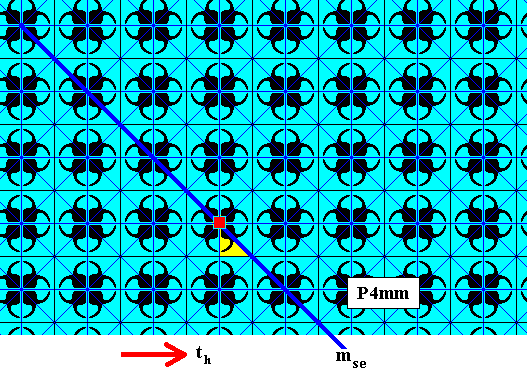
Figure 1 depicts the generating P4mm pattern and its generators.
Figure 1. Generating P4mm pattern, and its generators, p ( 900 anticlockwise rotation about the axis indicated by a small solid red square), reflection in the line mse , and the horizontal translation th . The identity element is indicated (yellow).

Figure 2. First phase of the derivation of the antisymmetry pattern, as specified above, from the generating P4mm pattern as depicted in Figure 7 of Part XXXI (and again in Figure 1).
The generating reflection mse is applied to the identity element. No color change is involved.

Figure 3. Second phase of the derivation of the antisymmetry pattern, as specified above.
The generating rotation p is repeatedly applied to the two elements already obtained in the previous Figure. No color change is involved. The result is a D4 rosette, consisting of eight elements.

Figure 4. Third phase of the derivation of the antisymmetry pattern, as specified above.
The antisymmetry translation e1th is repeatedly applied to the elements already obtained in the previous Figure. A color alternation is involved. The result is a horizontal band of elements.
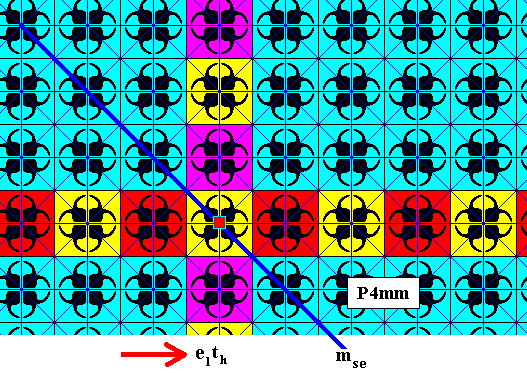
Figure 5. Fourth phase of the derivation of the antisymmetry pattern, as specified above.
The generating reflection mse is applied to the elements already obtained earlier. No color change is involved.

Figure 6. Beginning of fifth phase of the derivation of the antisymmetry pattern, as specified above.
The antisymmetry translation e1th is repeatedly applied to some elements already obtained in the previous Figure. A color alternation is involved.

Figure 7. Completion of fifth and final phase of the derivation of the antisymmetry pattern, as specified above.
The antisymmetry translation e1th is repeatedly applied to the rest of the elements already obtained in Figure 5. A color alternation is involved.
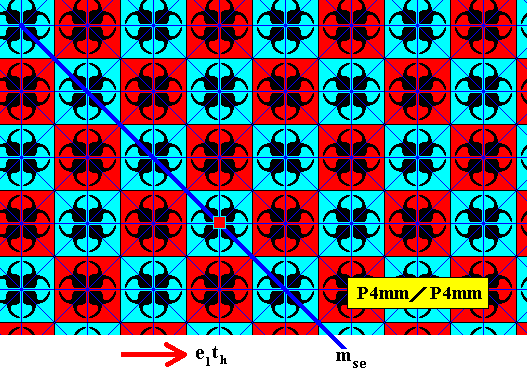
When we now restore yellow to blue and purple to red, we finally, get our antisymmetry pattern :
Figure 8. Antisymmetry pattern derived from the generating P4mm pattern according to the above specifications (by replacing the generating horizontal translation by its corresponding antisymmetry translation). The result is a coarse checkerboard-like pattern.
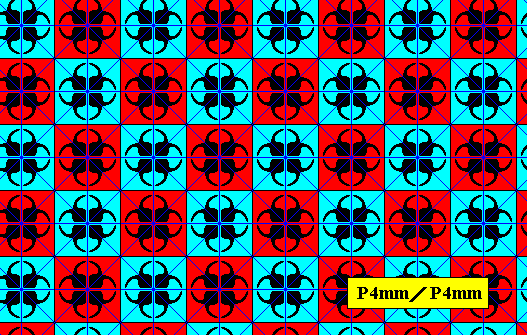
The next Figure gives that same antisymmetry pattern, but with the indications of symmetry elements (rotation axis, mirror line) omitted.
Figure 9. Same as previous Figure. Indications of symmetry elements (rotation axis, mirror line) omitted.
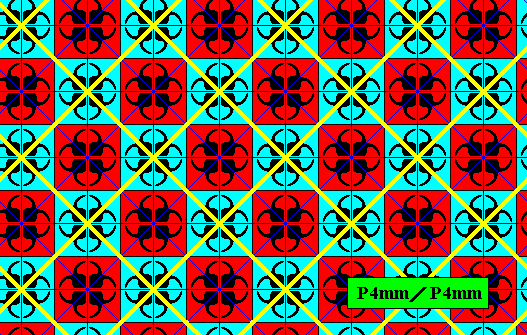
The next Figures give the point lattice of the just derived antisymmetry pattern.
Figure 10. Point lattice (indicated by yellow connection lines) of the above derived antisymmetry pattern. It is a square lattice. Compare with the point lattice of the generating P4mm pattern as it is depicted in Figure 3 of Part XXXI .
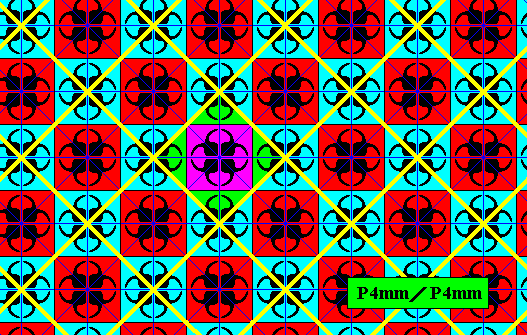
Figure 11. Point lattice (indicated by yellow connection lines) of the above derived antisymmetry pattern. A unit mesh is indicated by alternative colors.
In order to identify our antisymmetry pattern, we investigate its subpattern of blue elements (which contains the identity element) :
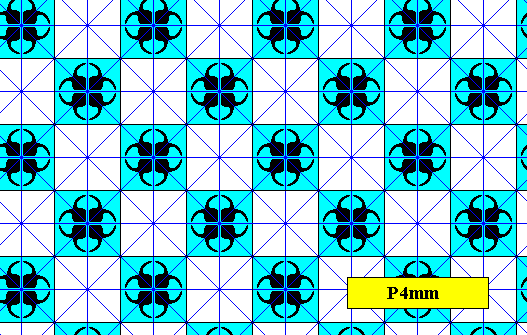
Figure 12. Subpattern of blue elements of the above derived antisymmetry pattern.

Figure 13. Subpattern of blue elements of the above derived antisymmetry pattern.
A possible way to geometrically represent group elements : eight areas representing group elements shown (green, red).
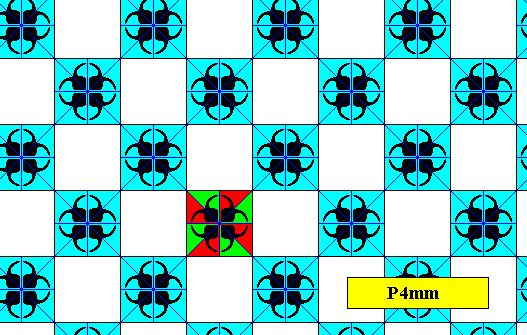
Figure 14. Subpattern of blue elements of the above derived antisymmetry pattern.
Another possible way to geometrically represent group elements : eight areas representing group elements shown (green, red). Some superfluous lines omitted.
The next Figures show the point lattice of the subpattern of blue elements.

Figure 15. Point lattice (indicated by red connection lines) of the subpattern of blue elements of the above derived antisymmetry pattern. It is a square lattice. Compare with the point lattice of the (corresponding) antisymmetry pattern, as it is depicted in Figure 10 . Compare also with the point lattice of the generating P4mm pattern, depicted in Figure 3 of Part XXXI .

Figure 16. Point lattice (indicated by red connection lines) of the subpattern of blue elements of the above derived antisymmetry pattern. A unit mesh is indicated by alternative colors.
From the above Figures it is clear that the subpattern of blue elements consists of a D4 motif that is repeated according to a square lattice. The mentioned D4 motifs are compatible with such a lattice. The pattern is in fact a diluted version of the generating P4mm pattern (Figure 1 ). Its symmetry therefore is that of the plane group P4mm .
The translations of the subpattern of blue elements, which are expressed by the edges of its lattice meshes, are also symmetry transformations of the generating P4mm patttern : These transformations are represented in the latter pattern by the sum of the vertical and the horizontal translation, as the next Figure shows.
Figure 17. Generating P4mm symmetry pattern.
Its translations are expressed by the edges of its lattice meshes. As such these translations are not symmetry transformations of the subpattern of blue elements, but the sum of those translations, i.e. the sum of a horizontal and vertical translation, is a symmetry transformation of the subpattern of blue elements. [Recall that a translation is just a vector, i.e. only a direction and a length, without a point of origin. It can start anywhere in the pattern. When the pattern is shifted according to this translation vector it will be perfectly superposed upon itself, which makes this translation a symmetry transformation.].
The next Figures give the distribution of symmetry elements (rotation axes, glide lines, mirror lines) of the subpattern of blue elements.

Figure 18. Distribution of symmetry elements in the subpattern of blue elements.
Four-fold and two-fold rotation axes. Compare with that of the generating P4mm pattern as depicted in Figure 4 of Part XXXI .
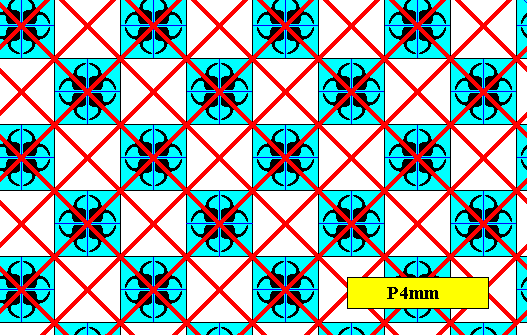
Figure 19. Distribution of symmetry elements in the subpattern of blue elements.
Diagonal mirror lines (strong red lines). Compare with that of the generating P4mm pattern as depicted in Figure 4 of Part XXXI (where the diagonal mirror lines are given as thin red lines).
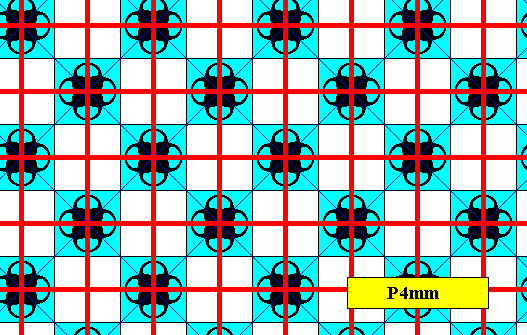
Figure 20. Distribution of symmetry elements in the subpattern of blue elements.
Horizontal and vertical mirror lines (strong red lines). Compare with that of the generating P4mm pattern as depicted in Figure 4 of Part XXXI (where the vertical and horizontal mirror lines are given as thin red and thick blue lines).

Figure 21. Illustration of a glide line ( g ) in the subpattern of blue elements.
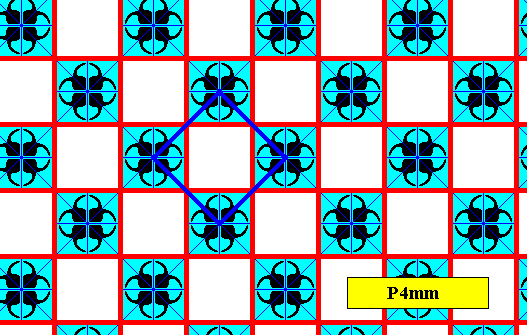
Figure 22. Distribution of symmetry elements in the subpattern of blue elements.
Glide lines (strong red lines). Compare with that of the generating P4mm pattern as depicted in Figure 5 of Part XXXI
From all the above it is clear that the subpattern of blue elements has P4mm structure and is a subgroup of the generating P4mm pattern (Figure 2 of Part XXXI ). Therefore, the symbol of the corresponding antisymmetry pattern (as was derived above, and depicted in Figure 8 ) must read P4mm / P4mm .
In the next document we will investigate a fourth antisymmetry pattern derivable from our generating P4mm symmetry pattern.
e-mail :
To continue click HERE for further group theoretic preparation to the study of the structure of three-dimensional crystals (crystallography) and the basic symmetry of organisms (promorphology).
Back to 3-dimensional crystals (conclusion), Organic Tectology and Promorphology
Back to the Beginning of the present Series on Subpatterns and Subgroups. There : LINK to Part XXVII
Back to Part XXVIII of the present Series
Back to Part XXIX of the present Series
Back to Part XXX of the present Series
Back to Part XXXI of the present Series
Back to Part XXXII of the present Series
Back to Part XXXIII of the present Series