e-mail :

Sequel to Group Theory
As always, we start with reminding the reader about the "Important Remark" near the end of Part III of Group Theory (To see it, click HERE and then go to (end of) Part III ), a Remark concerning the direction of reading products of group elements, like, say, apq. We read such products (from that Remark onwards) from back to front. Thus (with respect to apq) first q, then p, and then a.
Infinite two-dimensional periodic patterns, or Ornaments (sequel)
Sequel to the Plane Group P4mm
In the previous document we derived the first antisymmetry pattern from the generating P4mm symmetry pattern as depicted in Figure 7 of the previous document :
Figure 1. Antisymmetry pattern derived from the generating P4mm pattern (Figure 7 of the previous document ) by replacing the generating rotation by its corresponding antisymmetry rotation. The result is a checkerboard-like pattern.

Figure 2. Same as previous Figure, but with indications of generators removed.
The next Figure gives the point lattice of the just derived antisymmetry pattern.
Figure 3. Point lattice (indicated by strong yellow connection lines) of the just derived antisymmetry pattern. A unit mesh is given by alternative colors.
If we interpret this pattern as antisymmetry pattern, and thus (as such) possessing four-fold antisymmetry rotations, vertical and horizontal antisymmetry reflections, NE and SE diagonal reflections and glide reflections, then the lattice, as depicted here, must be interpreted as a s q u a r e lattice.
If, on the other hand, the pattern is not interpreted as an antisymmetry pattern, but just as an ordinary symmetry pattern (in which color change signifies an asymmetry, like, but now geometrically, we see it if we go from one 'half' of a comma-shaped motif to its other 'half' ), the lattice, as depicted here, must be interpreted as a r h o m b i c lattice (where the actually occurring squares are in fact special rhombuses) [or, equivalently, as a centered rectangular lattice as in Figure 13 ], because the pattern now only posseses two-fold rotations (half-turns), NE and SE diagonal reflections and glide reflections, which means an absence of 4-fold rotations, which in turn means that the two independent t r a n s l a t i o n s need not be perpendicular to each other : The 2-fold rotation axis and the two perpendicular (diagonal) mirror lines perfectly allow for an angle of the translations (and thus of the lattice mesh) different from 900. See also next Figure.

Figure 3a. A unit mesh possessing a four-fold rotation axis (antisymmetric or not) must have its edges equal and at right angles, i.e. the mesh must be a square (left image).
A unit mesh possessing a two-fold rotation axis (and not a 4-fold rotation axis) admits its edges making angles other than 900, i.e. the mesh can be a rhombus (right image).
NE and SE diagonal mirror lines are indicated.
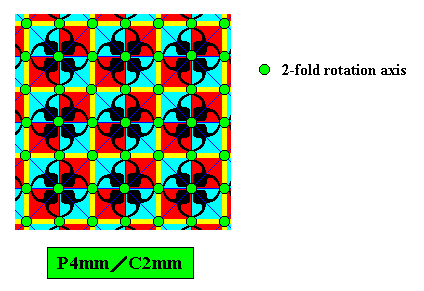
The next Figures (4 -- 9) give the distribution of symmetry elements (rotation axes, glide lines, reflection lines) of the above derived antisymmetry pattern, if NOT interpreted as antisymmetry pattern, but as ordinary symmetry pattern, where color change signifies asymmetry.
Figure 4. Distribution of symmetry elements of the above derived (antisymmetry) pattern (Figure 3 ), interpreted as ordinary symmetry pattern. Two-fold rotation axes. Four-fold rotation axes are absent.

Figure 5. Distribution of symmetry elements of the above derived (antisymmetry) pattern (Figure 3 ), interpreted as ordinary symmetry pattern. Mirror lines. Horizontal and vertical mirror lines are absent.
The next Figures illustrate glide lines (as just another type of symmetry element, in addition to the ones (rotation axes, mirror lines) shown above. These glide lines are common to the pattern-as-antisymmetry-pattern and the pattern-as-ordinary-symmetry-pattern.

Figure 6. Illustration of one of the glide lines of the above derived antisymmetry pattern. See also next Figures.

Figure 7. Illustration of one of the glide lines of the above derived antisymmetry pattern. The glide line itself ( g ) is indicated (purple line).

Figure 8. Illustration of one of the glide lines of the above derived antisymmetry pattern in the other direction. The glide line itself ( g ) is indicated (purple line).

Figure 9. Distribution of symmetry elements of the above derived (antisymmetry) pattern (Figure 3 ), interpreted as ordinary symmetry pattern. Glide lines (yellow, purple). As has been said, these glide lines are common to the pattern-as-antisymmetry-pattern and the pattern-as-ordinary-symmetry-pattern.
As already mentioned, the above derived antisymmetry pattern (Figure 3 ) can -- as any antisymmetry pattern -- be interpreted in two ways :

Figure 10. Implied antisymmetry reflections (in the yellow lines) of the above derived antisymmetry pattern, interpreted as antisymmetry pattern.
The next Figure shows the antisymmetry quarter-turns and the (normal) half-turns of the antisymmetry pattern derived above.
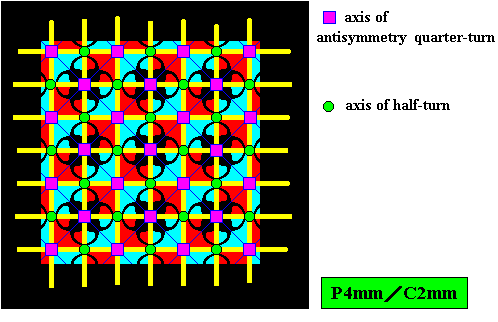
Figure 11. Antisymmetry quarter-turns and the (normal) half-turns of the antisymmetry pattern derived above, interpreted as antisymmetry pattern.
If, on the other hand, we interpret the above derived pattern as just a symmetry pattern (and thus not as an antisymmetry pattern), the lattice of the pattern, as it is depicted in Figure 3 , is -- although its meshes happen to be squares -- a r h o m b i c lattice (a square is a special kind of rhombus), and the symmetry of the pattern is then according to the plane group C2mm. Such a pattern allows, in addition to a rhombic lattice, also a c e n t e r e d rectangular lattice (where a square is also a special kind of rectangle), as the next Figures show.
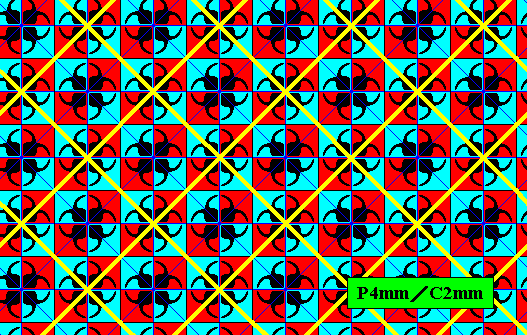
Figure 12. Centered rectangular point lattice (indicated by yellow connection lines) of the above derived antisymmetry pattern, but here interpreted as just a symmetry pattern (where color change indicates an asymmetry). A unit mesh contains five equivalent (lattice) points, viz. one at each corner, and one in its center. See also next Figure.

Figure 13. Same as previous Figure. A unit mesh is indicated by dark blue outline and alternative colors. The five lattice points associated with this unit mesh are indicated (small solid green circles). Compare with Figure 3 .
So the symmetry of the pattern, when interpreted just as a symmetry pattern, is indeed according to the plane group C2mm [centered rectanglar or rhombic lattice (accounting for translations), (only) two (types of) reflections perpendicular to each other, implied glide reflections, implied half-turns, and no quarter-turns]. In this way our pattern represents a desymmetrization from P4mm to C2mm.
In order to identify the pattern as antisymmetry pattern, i.e. in order to determine its antisymmetry symbol, we will investigate its subpattern of blue elements which contains the identity element, i.e. the identity element of the antisymmetry pattern [Recall that the identity element of an antisymmetry pattern is never affected by antisymmetry, it never changes color. So in our case it must be among the blue elements.] as well as (being the identity element) of the generating P4mm pattern.

Figure 14. Subpattern of blue elements of the antisymmetry pattern obtained above (Figure 2 ).
The next Figures indicate the centered rectangular point lattice of the just isolated subpattern of blue elements.

Figure 15. Centered rectangular point lattice (indicated by strong red connection lines) of the subpattern of blue elements of the antisymmetry pattern obtained above. Each lattice mesh has five equivalent points : one at each of its corners and one in its center. See also next Figure.

Figure 16. Same as previous Figure. A unit mesh and its five equivalent points are highlighted. Compare with the centered rectangular lattice of the antisymmetry pattern (interpreted as just a symmetry pattern) as depicted in Figure 13 .
So the subpattern of blue elements consists of a periodical arrangement of D2 motifs (four partly overlapping commas) according to a centered rectangular lattice (in which the meshes in the present case happen to be squares -- a special kind of rectangle). Therefore the symmetry of this subpattern is according to the plane group C2mm .
Such a pattern also admits of a rhombic lattice describing its periodicity :

Figure 17. Rhombic lattice (indicated by strong red connection lines) of the subpattern of blue elements. A unit mesh has four equivalent points. Its shape happens to be a square (which is, however, a special kind of rhombus). The original identity element is indicated (purple). Compare with the lattice of the antisymmetry pattern (Figure 3 ).
The subpattern of blue elements can be generated by applying the reflection in the line m (Figure 17) to the identity element, then applying to the result a half-turn (its axis indicated in the Figure as a small solid green circle), then applying the horizontal translation th to the result, then reflection of the result in the line m , and finally again applying the horizontal translation to the result. If we now look to Figure 7 of the previous document we see that the generators of the subpattern of blue elements are also elements of the generating P4mm pattern (where the half-turn of the former shows up as p2 of the latter). Further we see that the quarter-turn, which is an element of the generating P4mm pattern, is not an element of the subpattern of blue elements.
The next Figures analyse the subpattern of blue elements still further, namely as to the distribution of its symmetry elements (rotation axes, reflection lines, glide lines).

Figure 18. Subpattern of blue elements.
Distribution of its 2-fold rotation axes. Compare with that of the (antisymmetry) pattern (Figure 4 ) as interpreted as an ordinary symmetry pattern.

Figure 19. Subpattern of blue elements.
Distribution of its mirror lines. Compare with that of the (antisymmetry) pattern (Figure 5 ) as interpreted as an ordinary symmetry pattern.

Figure 20. Subpattern of blue elements.
Distribution of its glide lines. Compare with that of the (antisymmetry) pattern (Figure 9 ) as interpreted as an ordinary symmetry pattern.
The above Figures show that the algebraic structure of the subpattern of blue elements -- which is that of C2mm -- is identical to that of the above derived antisymmetry pattern as soon as this latter pattern is NOT interpreted as an ANTIsymmetry pattern, but just as an ordinary symmetry pattern, where color change means some asymmetry. If, on the other hand, we interpret the antisymmetry pattern as ANTIsymmetry pattern, then -- as we saw above -- its algebraic structure is that of P4mm (with 4-fold antisymmetry rotations, 2-fold rotations, reflections, antisymmetry reflections, and glide reflections).
In the next document we will investigate other antisymmetry patterns derivable from the generating P4mm pattern of Figure 7 of the previous document .
e-mail :
To continue click HERE for further group theoretic preparation to the study of the structure of three-dimensional crystals (crystallography) and the basic symmetry of organisms (promorphology).
Back to 3-dimensional crystals (conclusion), Organic Tectology and Promorphology
Back to the Beginning of the present Series on Subpatterns and Subgroups. There : LINK to Part XXVII
Back to Part XXVIII of the present Series
Back to Part XXIX of the present Series
Back to Part XXX of the present Series
Back to Part XXXI of the present Series