e-mail :

Sequel to Group Theory
As always, we start with reminding the reader about the "Important Remark" near the end of Part III of Group Theory (To see it, click HERE and then go to (end of) Part III ), a Remark concerning the direction of reading products of group elements, like, say, apq. We read such products (from that Remark onwards) from back to front. Thus (with respect to apq) first q, then p, and then a.
Infinite two-dimensional periodic patterns, or Ornaments (sequel)
Sequel to the Plane Group P4mm
In the previous document we were analysing a P4mm / P4gm antisymmetry pattern, derived from a square tiling, depicted in Figure 3a of the previous document . Here we will continue this analysis. We will pick up the numbering of the Figures where we left it (Figure 22) in the previous document.
The next Figures are about the glide lines that can be detected in the just derived antisymmetry pattern (Figure 21 of the previous document ).
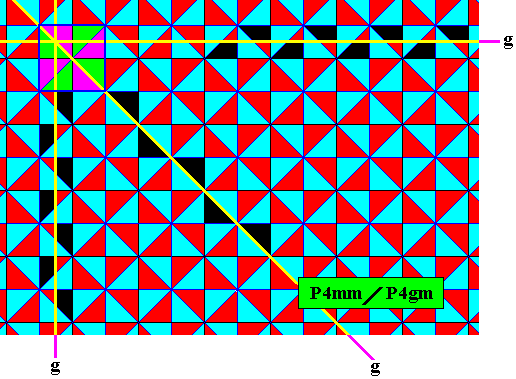
Figure 23. The three types (horizontal, vertical, diagonal) of glide lines that can be detected in the just derived antisymmetry pattern. A choice of unit mesh is indicated by alternative colors. Another possible choice is indicated in the next Figure.
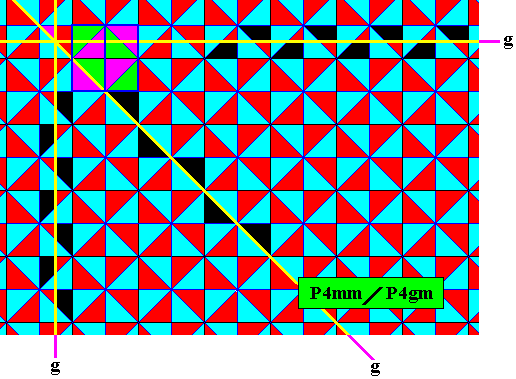
Figure 23a. The three types (horizontal, vertical, diagonal) of glide lines that can be detected in the just derived antisymmetry pattern. Alternative choice of unit mesh indicated.
Let's look to these glide reflections more closely (and see the Figures below).
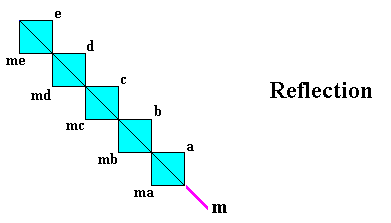
Figure 24. The diagonal line is a reflection line. The elements a, b, c, d, e are reflected in the line m resulting in the elements ma, mb, mc, md, me .
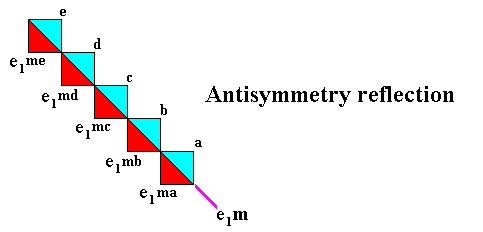
Figure 25. The diagonal line is an antisymmetry reflection line. The elements a, b, c, d, e are reflected in the line e1m , i.e. they are reflected and at the same time change color, resulting in the elements e1ma, e1mb, e1mc, e1md, e1me .
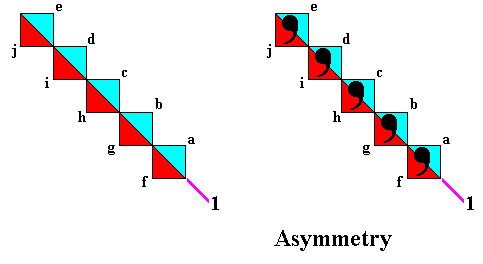
Figure 26. The diagonal line is not a symmetry element (i.e. it does not represent an axis, mirror line, glide line, or whatever). It signifies an asymmetry. If we nevertheless want to express this line as a symmetry element, it then is the trivial symmetry element, viz. the axis 1 , meaning a one-fold rotation axis (i.e. relating to a rotation (via a third dimension) about this axis of 00 or 3600 ). This 'symmetry transformation' superimposes every object whatsoever upon itself. The elements a, b, c, d, e cannot be transformed into the elements f, g, h, i, j by any symmetry transformation.
Both images of the Figure are equivalent with respect to the status of the diagonal line. The commas just emphasize the asymmetry.
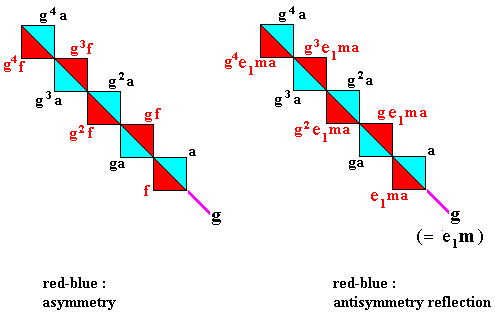
Figure 27. The diagonal line is a glide line.
In the left image of the Figure the color change represents asymmetry. So when an element is reflected in the (glide) line g we do not find an image of this element. We only find it to be shifted along the line. So our line is indeed a glide line.
In the right image of the Figure the color change represents a transformation, viz. an antisymmetry reflection. If we reflect, say, the element a in the (diagonal) line, i.e. if we just reflect it (i.e. we now talk about a normal reflection, not an antisymmetry reflection) we do not find the (blue) image of this (normal) reflection directly on the other side of the line (we find instead an element (red) e1ma resulting from an antisymmetry transformation e1m applied to the element a ). However, we find this image shifted along the line, as the element ga . So the diagonal line is also in this case a glide line.
So whether the color change is interpreted as an asymmetry or as an antisymmetry transformation, in both cases the diagonal line is a true glide line.
In the right image of the Figure we can see that ga = e1mge1ma = e1e1mgma (because e1 commutes with every other element) = mgma (because e1e1 =1) = gmma (because m and g commute) = ga (because mm = 1) .
In the same way g2a = e1mg2e1ma = e1e1mg2ma = mggma = gmmga = gga = g2a .
In order to understand all this, but now in the context of the whole pattern (i.e. either the generating P4mm symmetry pattern, or the antisymmetry pattern derived from it, or the last mentioned pattern not interpreted as an antisymmetry pattern), we need to consider again the symmetry of the generating P4mm pattern from which the present antisymmetry pattern was derived. It was depicted in Figure Figure 3a of the previous document, and its motif is a square plus its empty content, covering -- because of its inherent symmetry -- eight group elements. In Figure 4 we see this same pattern with the group element boundaries now explicitly given, and in Figure 4a we see, in addition to these boundaries, the motifs s.str. emphasized (strong black lines).
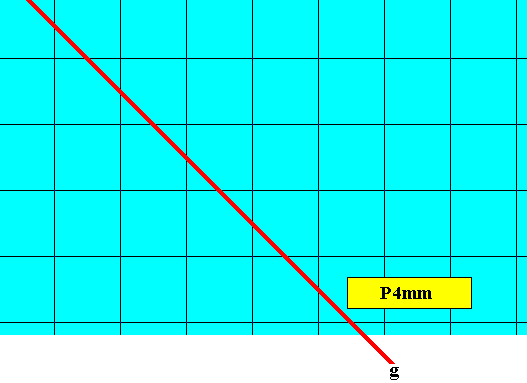
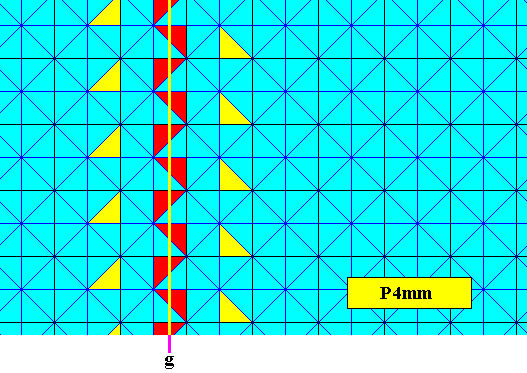
Figure 28. Generating P4mm pattern from which the antisymmetry pattern (Figure 21 ) was derived above (previous document). One of its diagonal glide lines (g) indicated.
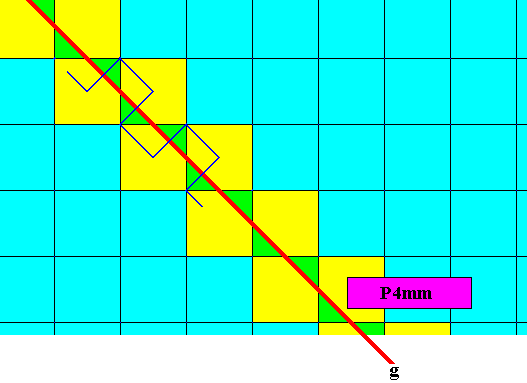
Figure 29. Generating P4mm pattern from which the antisymmetry pattern (Figure 21 ) was derived above (previous document). One of its diagonal glide lines (g) indicated and elucidated.
Such glide lines are also present in the antisymmetry pattern (as antisymmetry pattern) derived from the generating pattern just mentioned (previous Figure) :
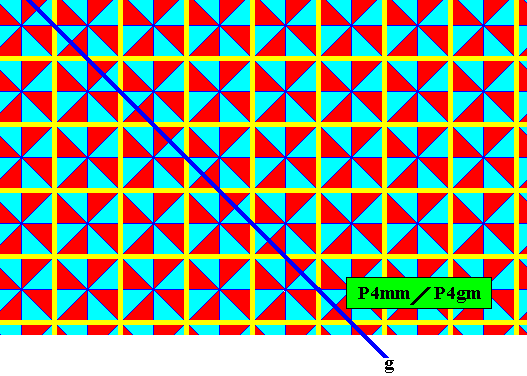
Figure 30. The above derived antisymmetry pattern possesses diagonal glide lines. One of them ( g ) is indicated. It is further elucidated in the next two Figures. The yellow lines (which can cosignify lattice connection lines) signify the m o t i f s of the antisymmetry pattern (each of them consisting of eight motif units representing group elements).
The next two Figures elucidate this glide line.
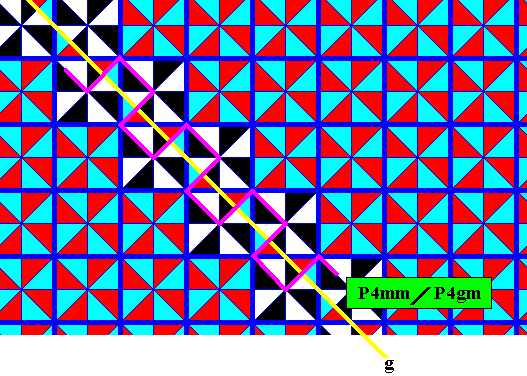
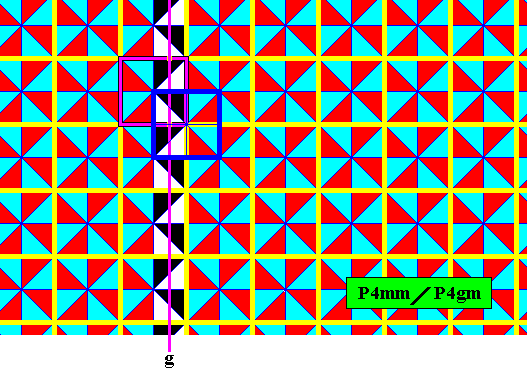
Figure 31. Highlighting of the diagonal glide line (one out of many) of the above derived antisymmetry pattern. Strong blue lines indicate the pattern's motifs.
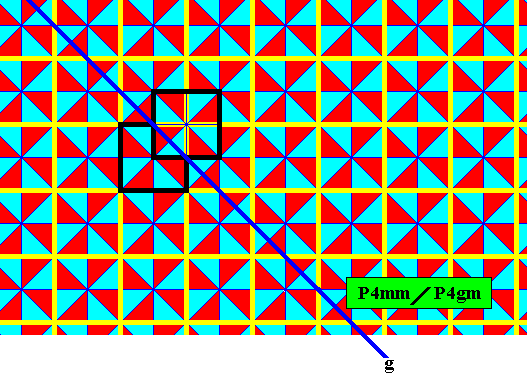
Figure 32. The diagonal glide line (one out of many) of the above derived antisymmetry pattern is indeed a genuine glide line : When we reflect a motif (black square) in that line, the image (produced by that reflection) does not coincide with an existing motif (but falls between the motifs). If it did coincide, the line would be a reflection line. But if we directly shift this image along the (glide) line we find such an existing motif (onto which the image falls). So the (glide) line is indeed a true glide line. If the pattern would not be interpreted as an antisymmetry pattern, but just as a symmetry pattern, the line would be a mirror line. This is shown in the next Figure.
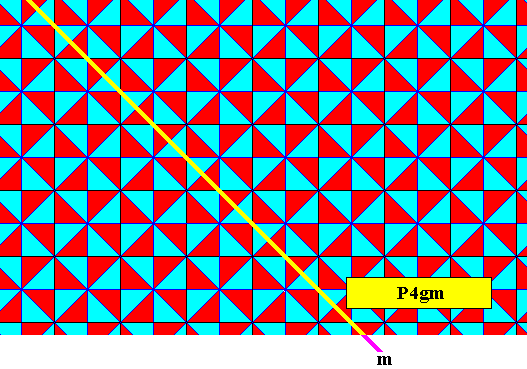
Figure 32_1. The diagonal glide line of the above derived antisymmetry pattern, and shown in the previous Figure, is not a glide line, but a reflection line, as soon as the pattern is not interpreted as an antisymmetry pattern. Its symmetry is then according to the plane group P4gm .
Parallel and close to the diagonal glide line we see in the antisymmetry pattern (as antisymmetry pattern) a diagonal reflection line, in fact, an antireflection line. See next Figure.
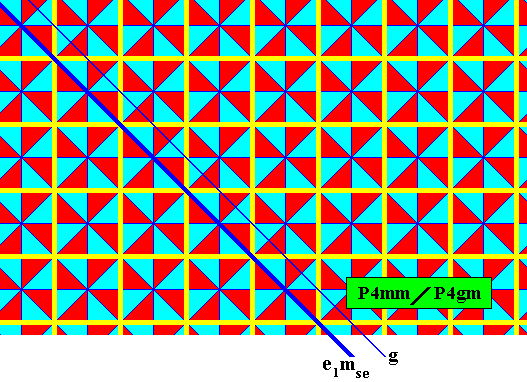
Figure 32a. Diagonal antireflection line e1mse in the antisymmetry pattern (as antisymmetry pattern) under investigation. The motifs (indicated as yellow squares) are properly reflected, and the background color interchanged under this (antisymmetry) transformation.
If the pattern were interpreted as just a symmetry pattern, this line would be a glide line, while the (glide) line g would be a mirror line.
So far so good for diagonal lines.
The next Figure suggests that our generating P4mm pattern ( Figure Figure 3a, and (provided) with group element boundaries in Figure 4 ) also has vertical (and horizontal) glide lines.
Figure 33. The generating P4mm symmetry pattern, used in the previous document to derive an antisymmetry pattern, seems to possess, in addition to diagonal glide lines (shown above), vertical (and horizontal) glide lines, while any P4mm pattern is supposed to have only diagonal glide lines.
To sort this out, let's first again depict the generating P4mm pattern.
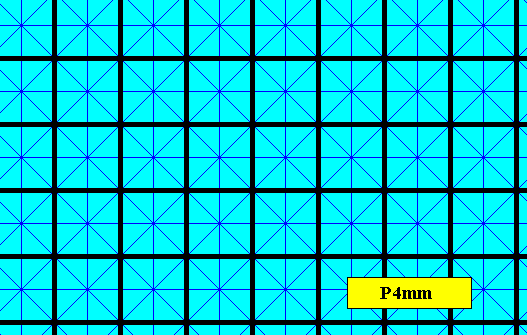
Figure 34. The generating P4mm symmetry pattern from which the antisymmetry pattern was derived (previous document). All the lines, thick or thin, are group element boundaries. The thick black lines moreover indicate the pattern's motifs. The motif is in fact the content of the square enclosed by those (thick) lines plus these boundaries themselves. The latter are given as thick lines, but only so in order to distinguish them from the other lines that only take part in indicating the boundaries of the areas representing group elements.
The next Figure shows that the line g in Figure 33 (and all its equivalents, vertical or horizontal) cannot be a glide line if we clearly distinguish motif features from lines of which the only function is to represent borders of the areas representing group elements.
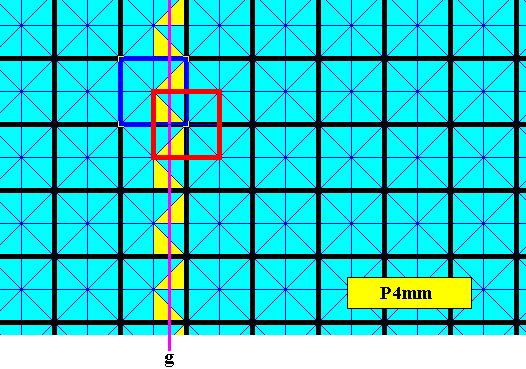
Figure 35. The generating P4mm symmetry pattern from which the antisymmetry pattern was derived (previous document). The line g (and all its equivalents) cannot be a glide line : The images resulting from the action of this alleged glide reflection (in the line g ) do not coincide with existing structures (which means that the pattern is not superposed upon itself by this alleged glide reflection, which in turn means that the latter is not a symmetry transformation of the pattern).
That it is in virtue of the motifs that our generating P4mm pattern does not possess vertical or horizontal glide lines (only diagonal ones) can clearly be seen in the generating P4mm pattern that we have used in earlier documents to derive antisymmetry patterns. In this generating symmetry pattern the motifs are more clearly expressed than in our present generating P4mm pattern. See next Figure.
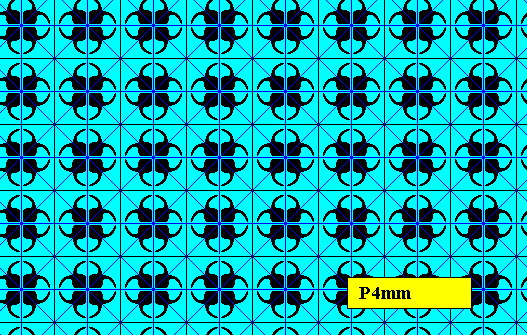
Figure 36. Generating P4mm symmetry pattern used in earlier documents (to derive from it antisymmetry patterns). It has clearly expressed motifs.
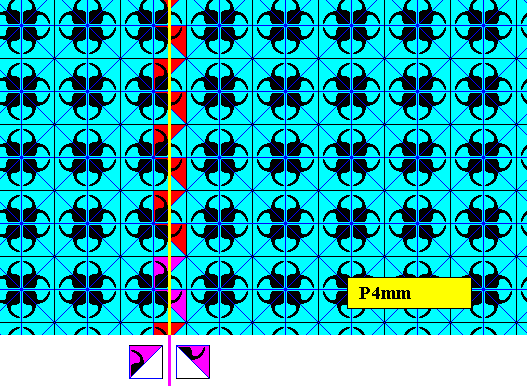
Figure 37. Generating P4mm symmetry pattern used in earlier documents. It does not possess vertical and horizontal glide lines : The original and its image under an alleged vertical glide reflection are not mirror images of each other. In the generating P4mm used in the previous document (Figure 3a ) they are mirror images of each other, which can be seen in Figure 35 , but the image of the alleged glide reflection ends up at the wrong place, i.e. it is not superimposed upon an identical motif structure already existing. Also in the present Figure the image under the alleged glide reflection of the motif will not be superimposed upon an identical motif structure already present at the right place. All this demonstrates the importance of what exactly is considered to be a motif of the pattern.
Also, and because of the same reason (namely motifs), in the corresponding antisymmetry pattern (as derived in the previous document) the line g (and of course all its equivalents, vertical or horizontal) cannot represent a glide line. See next Figure. But as soon as we do not interpret the pattern as antisymmetry pattern anymore, or, equivalently, consider (only) its subpattern of blue elements, the motifs have changed, i.e. they are not those squares anymore, but are now the (smallest) triangles, formed by the boundaries of the group elements.
Figure 38. The line g (and all its equivalents) in the antisymmetry pattern cannot represent a glide line. Also here the images of the motifs under this alleged glide reflection do not coincide with existing structures (meaning that the pattern will not be superposed upon itself under this transformation).
The next Figure elaborates on the vertical glide lines outside the context of the whole pattern.
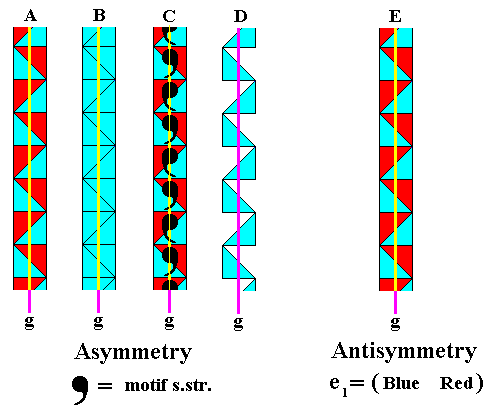
Figure 38a. Vertical one-dimensional patterns (friezes) (A, B, C, D, E).
Whether color change is interpreted as asymmetry (A), or whether there is (also) geometrical asymmetry ( B, C ), or whether alternating elements are left out (equivalent to the first mentioned asymmetry) (D), or whether color alternation is interpreted as antisymmetry ( E ), in all these cases the line g is a true glide line.
Let us now investigate whether the vertical (and horizontal) lines -- as exemplified by the line g above (Figure 38 ) -- are glide lines if we interpret the (antisymmetry) pattern not as an antisymmetry pattern, but just as a symmetry pattern, where the color change signifies asymmetry. This is equivalent to eliminate all red elements of the pattern and preserving only its subpattern of blue elements (containing the identity element). Let us first give the antisymmetry pattern again, thereby emphasizing its motifs :
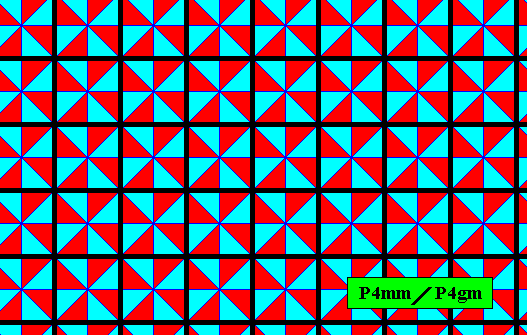
Figure 39. Above derived antisymmetry pattern. Its motifs are represented by black squares (and empty content). Each consists of eight triangular areas representing group elements. These triangular areas also represent motif units.
Let us now isolate the subpattern of blue elements of our antisymmetry pattern :
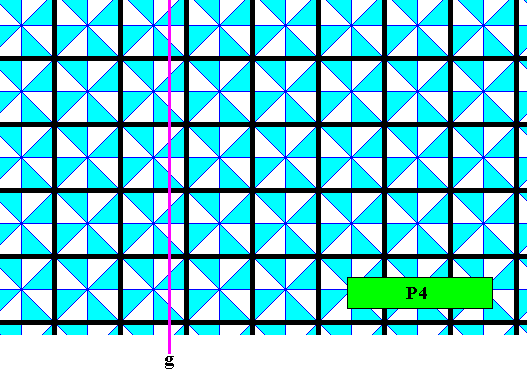
Figure 40. Red elements erased from the above antisymmetry pattern.
In the above Figure we can see that the line g (and all its equivalents) can still not represent a glide line, in virtue of the same reasons as were put forward above. But this is because in erasing the red elements we did not take the motifs into account. In fact, by isolating the subpattern of blue elements all the lines now become motif boundaries. The next Figure shows this.
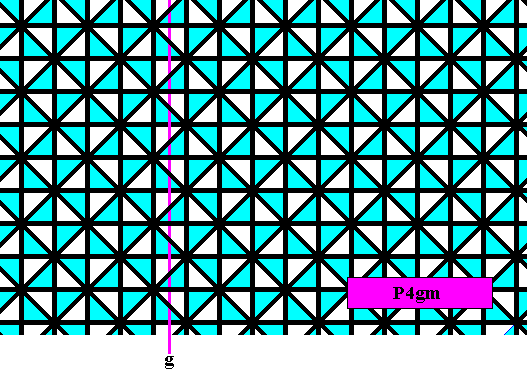
Figure 41. Red elements erased from the above antisymmetry pattern. As a consequance all the lines now become motif boundaries.
And now we clearly see that the line g (and all its equivalents, vertical as well as horizontal) is a true glide line, because the images of the glide reflection in that line can be superposed upon same existing structures. See next two Figures.
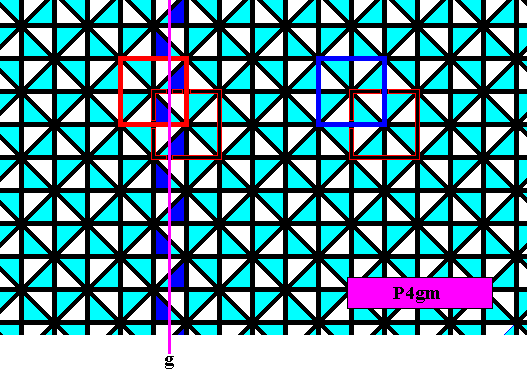
Figure 42. The subpattern of blue elements (extracted from the above derived antisymmetry pattern) has vertical and horizontal glide lines. One vertical glide line highlighted.
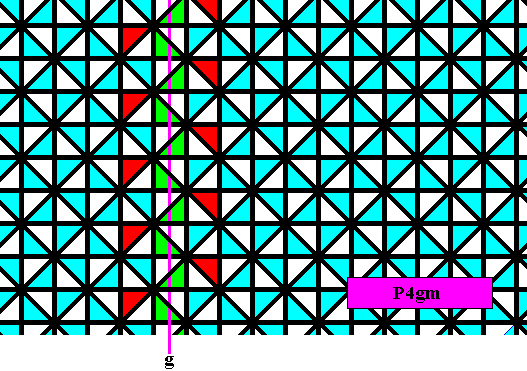
Figure 43. The subpattern of blue elements (extracted from the above derived antisymmetry pattern) has vertical and horizontal glide lines. One vertical glide line highlighted. The next Figure shows that it has also diagonal glide lines.
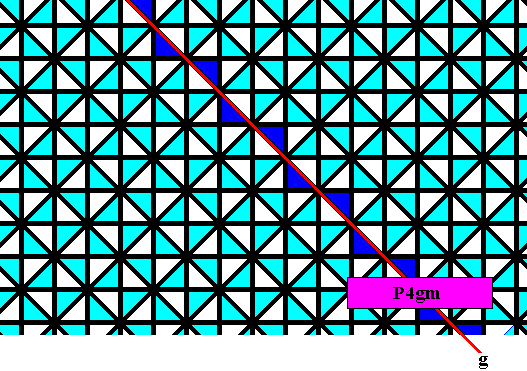
Figure 44. The subpattern of blue elements, as established above. It possesses diagonal glide lines (one of them highlighted).
The demonstrated existence of diagonal, horizontal and vertical glide lines (where the diagonal ones make 450 angles with the horizontal and vertical ones) already proves that the symmetry of the subpattern of blue elements is according to the plane group P4gm .
The next Figures give the whole system of glide lines of the antisymmetry pattern derived above, i.e. in the previous document, provided this pattern is not interpreted as an antisymmetry pattern, but just as a symmetry pattern, where color change (red <==> blue) signifies asymmetry. As such it is equivalent to its subpattern of blue elements, as discussed above.
Figure 45. The full system of glide lines, present in the above derived antisymmetry pattern. This full system of glide lines is as such only present if the pattern is not interpreted as an antisymmetry pattern, but just as a symmetry pattern, where color change signifies asymmetry (Such an asymmetry -- here expressed as color change, can -- in other cases -- also be present geometrically, for example when we consider the two halves of a comma (as a motif s.str. of a pattern) : there is no symmetry transformation that can bring us from one half to the other). The pattern, here depicted, has, if not interpreted as an antisymmetry pattern, a symmetry according to the plane group P4gm .
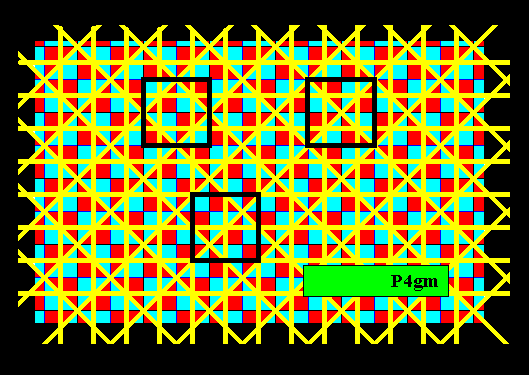
Figure 46. Same as previous Figure. Some possible choices of unit meshes are indicated.
The next Figure has erased all the red elements of the pattern of the above two Figures (which is essentially the same as interpreting the latter not as an antisymmetry pattern), resulting in the subpattern of blue elements provided with its system of glide lines (yellow). The m o t i f s of this subpattern are the blue right-angled isosceles triangles, each representing one group element.
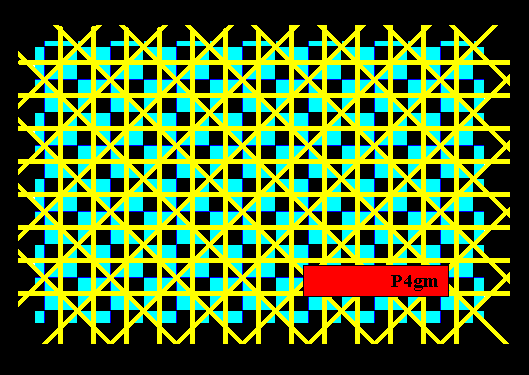
Figure 47. Same as previous Figure, but now all red elements removed. The result is the subpattern of blue elements. Whereas in the antisymmetry pattern (as antisymmetry pattern) and also in the generating P4mm symmetry pattern, the motif (square plus empty, i.e. not patterned content) consisted of eight motif units, each representing a group element, in the subpattern of blue elements the motif is now equal to the former motif unit (right-angled isosceles triangle) and represents one group element.
We know that the symmetry of the pattern of blue elements is according to the plane group P4gm . We must now determine whether it is a subgroup of the generating P4mm pattern. In fact this is -- as we shall see -- directly evident. It is, however, still instructive to consider in detail the symmetry content of both patterns. For this we must look to the symmetry elements (glide lines, mirror lines, rotation axes) in these patterns. This we will do in the next document, where we pick up the numbering of the Figures from where we left it here.
e-mail :
To continue click HERE for further group theoretic preparation to the study of the structure of three-dimensional crystals (crystallography) and the basic symmetry of organisms (promorphology).
Back to 3-dimensional crystals (conclusion), Organic Tectology and Promorphology
Back to the Beginning of the present Series on Subpatterns and Subgroups. There : LINK to Part XXVII
Back to Part XXVIII of the present Series
Back to Part XXIX of the present Series
Back to Part XXX of the present Series
Back to Part XXXI of the present Series
Back to Part XXXII of the present Series
Back to Part XXXIII of the present Series
Back to Part XXXIV of the present Series
Back to Part XXXV of the present Series
Back to Part XXXVI of the present Series
Back to Part XXXVII of the present Series